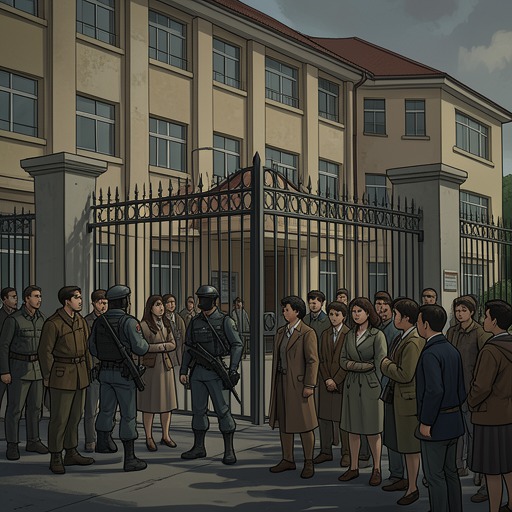
Midtown School of the Arts
On the Come UpMidtown School of the Arts is a private school in the affluent Midtown neighborhood, attended by students from across the city through a busing program described by the school as a diversity initiative. For Brianna Jackson and other students from Garden Heights, it offers an alternative to their local school, but access does not mean equal treatment: security practices, public controversy, and student organizing expose a sharp divide between the school’s inclusive image and the experiences of its Black and Latinx students.
Setting and access
Midtown School of the Arts sits in a neighborhood of expensive historic houses and condominiums, far from the circumstances of many students it buses in. Brianna lives in the zone for Garden Heights High, but her mother, Jayda Jackson, considers that school too troubled and insufficiently invested in its students. Private tuition is beyond the family’s means, so Midtown becomes the next-best option. A few years before the events of the novel, the school began transporting students from around the city under a program it called its diversity initiative.
The program brings together affluent students from the north side, middle-class students from downtown and Midtown, and students from poorer neighborhoods. Only fifteen students from Garden Heights attend. The short yellow bus that collects them makes the school’s geography visible: Midtown’s promise of access depends on transporting a small group from outside its wealthy neighborhood, rather than on the neighborhoods themselves having equal educational resources. For Jayda, the initiative’s official rationale is less persuasive than its likely institutional benefit: she suspects the school wanted grant money and would not have received it if it served only white students.
The family’s financial limits also shape Brianna’s daily school life. After most students have left, she attends ACT preparation on Tuesday and Thursday afternoons, as Jayda insists she should aim near a perfect score because she has paid substantially for the class. At the start of each session, Brianna gives her phone to Mrs. Murray. The routine shows the family investing in educational opportunity even while money is tight; the school is not simply a backdrop, but a place where access is pursued through specific sacrifices and expectations.
Security and unequal treatment
Security becomes a defining feature of the school’s daily experience. At one screening, a woman and a man Brianna has never seen direct students through metal detectors one at a time. On another occasion, students wait in line while Sonny asks whether Officers Long and Tate have calmed down since the previous day. His question places the checkpoint within an already tense relationship between students and security staff.
Brianna passes through the metal detector without triggering it, but Long still orders her to go back. He takes hold of her arms and restrains her while Tate removes her backpack. The school’s subsequent account acknowledges that the guards used excessive force and that Brianna was put on the floor. The contrast is concrete: the detector gives no alert, yet the encounter proceeds as a physical intervention, making clear that the process is not explained by an alarm alone.
At the meeting that follows, Principal Dr. Rhodes promises an investigation and says disciplinary action may result if the administration finds it appropriate. She also raises the possibility that Brianna herself may face discipline and asks whether she has been selling candy on campus. Jayda challenges the framing: she says her son had previously told her that guards singled out certain students, and she objects to the implication that her children are inventing what happened. The exchange leaves institutional accountability conditional while placing Brianna’s conduct under scrutiny.
The school’s security measures become a broader public concern after the confrontation. At a packed meeting in the auditorium, a parent questions metal detectors, random pat-downs, and armed police, objecting that students should not be treated as though they were in prison. Shana Kincaid, a junior, tells Superintendent Cook that Long and Tate were known to target Black and Latinx students more than others. She describes disproportionate pat-downs, random locker checks, and secondary screenings, as well as physical confrontations with the officers. The arrival of armed police, she says, leaves students fearing for their lives at school.
Jayda adds the family’s direct experience to that account: Brianna, she says, was physically assaulted by the officers because she sold candy, not drugs. Her statement identifies both the immediate source of suspicion and the stakes of misclassification. Brianna’s candy-selling is treated as a possible disciplinary issue even as the family contests the security response, and the incident becomes part of an argument about how ostensibly routine school procedures can impose different burdens on students of color.
Student response and public controversy
The school also becomes a site of collective organization. Malik tells Brianna that students have formed an unofficial Black and Latinx student coalition. After Long and Tate are named in the conflict, almost every Black and Latinx student from Midtown gathers at Malik’s home in less than an hour. Their response moves beyond an individual complaint: students create a shared space in which the security incident and unequal treatment can be addressed collectively.
Brianna’s own response extends the dispute into public interpretation. When challenged about her behavior, she argues that speaking up for herself should not be called “ratchet” and points to the videos of the incident as evidence of what she did. The footage matters because it contests a description of her that might otherwise turn attention away from the guards’ actions. The school is thus connected not only to the original confrontation but to the struggle over how that confrontation is represented and judged.
That struggle widens when news coverage associates Brianna’s song “On the Come Up” with school violence. A television report identifies the track as hers, displays her Dat Cloud page, and describes its lyrics as violent, including attacks on law enforcement; it also says the song is popular with young listeners. The report places Brianna’s artistic expression alongside the school controversy, encouraging an interpretation of her as a threat rather than distinguishing a song from the conduct that prompted the campus dispute.
In a radio interview, Hype objects to lyrics about being armed and seeming to threaten to kill police. Brianna points to the double standard in how a sixteen-year-old girl’s lyrics are received compared with those of her father, who rapped about similar material at sixteen. The episode broadens the school’s significance: arguments over security and discipline are connected to the gendered and racialized interpretation of Brianna’s voice beyond the campus.
Institutional image and narrative significance
Midtown School of the Arts is marked by a recurring gap between institutional assurances and students’ accounts. The school offers a route into an educational setting otherwise unavailable to Brianna’s family, and its diversity initiative brings students from across the city together. Yet the metal detectors, searches, possible disciplinary action, and deployment of armed officers make that access feel conditional, especially for Black and Latinx students who say they face more scrutiny.
The school’s meetings provide a forum for parents and students to question those practices, but the evidence of the novel’s conflicts remains unevenly distributed: Brianna and her family must defend her behavior even after the administration acknowledges excessive force, while students describe a pattern extending beyond her single encounter. Midtown therefore functions as both an opportunity and a battleground. Its central tension is not simply whether the school admits students from different neighborhoods, but whether those students can enter its halls without being treated as presumptive threats.